
A tour that promised visits to six national parks in the American Southwest was so tempting that my sister, my usual traveling companion, and I quickly signed up. We traveled with Tauck Tours, known for its premium, nearly all-inclusive experiences featuring exclusive access to landmarks, premier hotel stays, and expert local guides.
We have both visited many national parks over the years, including the Grand Canyon, Yellowstone, and Yosemite. One of my fondest memories is a family trip to Yellowstone when we were young girls. The highlight? Each of us got to get a cowboy hat!
Our itinerary included six national parks in ten days, although the sixth was to be viewed from the air and was canceled because of bad weather. We visited five remarkable parks: Arches, Canyonlands, Bryce Canyon, Zion, and, as the grand finale, two nights on the South Rim of the Grand Canyon. Before we left, we were advised to prepare for every kind of weather—from desert heat to mountain chill. We packed shorts, T-shirts, wide-brimmed hats, fleece jackets, puffer coats, and even gloves. We ended up using every one of them.
Our adventure began in Grand Junction, Colorado, where we were met and driven to Red Cliffs Lodge near Moab, Utah, our home for three nights. We had anticipated dramatic scenery, and we were not disappointed. Towering red rock cliffs rose above the Colorado River as it wound past the lodge. One afternoon, we floated down the Colorado River. There were no white-water rapids, just a peaceful ride surrounded by spectacular red cliffs. Our guides pointed out movie locations where many classic John Wayne westerns were filmed, along with more recent productions, including City Slickers II.
Our first national park was Arches, an ideal introduction to the Southwest’s extraordinary landscape. We followed the scenic drive through the park, stopping at overlooks and taking short hikes to admire the park’s remarkable sandstone arches and rock formations. The next day we visited Canyonlands, where the landscape changed dramatically. Standing high above the deep canyons carved by the Colorado and Green Rivers, we caught our first glimpse of the dramatic views that would later be echoed at the Grand Canyon.
Our next stop took us to higher elevations and Bryce Canyon National Park. What a difference a day—and several thousand feet of elevation—can make. A cold front arrived overnight, and the first morning we awoke to an unexpected blanket of snow. Grateful for the warm clothing we had packed, we bundled up and hurried to the canyon rim. The park’s famous hoodoos—those tall, slender rock spires—looked magical dusted with fresh snow.
Leaving Bryce, we headed to Zion National Park, where yet another unique landscape awaited us. Instead of looking down into a canyon, we found ourselves standing on its floor, surrounded by soaring sandstone walls. Zion is a hiker’s paradise. The most unique and popular hike is The Narrows, where visitors actually hike in the Virgin River. At its narrowest point, the canyon walls rise nearly 1,000 feet while the river may be only 20 to 30 feet wide. Outfitters provide dry bibs, neoprene socks, and sturdy hiking poles for those willing to experience one of the park’s most unusual hikes.
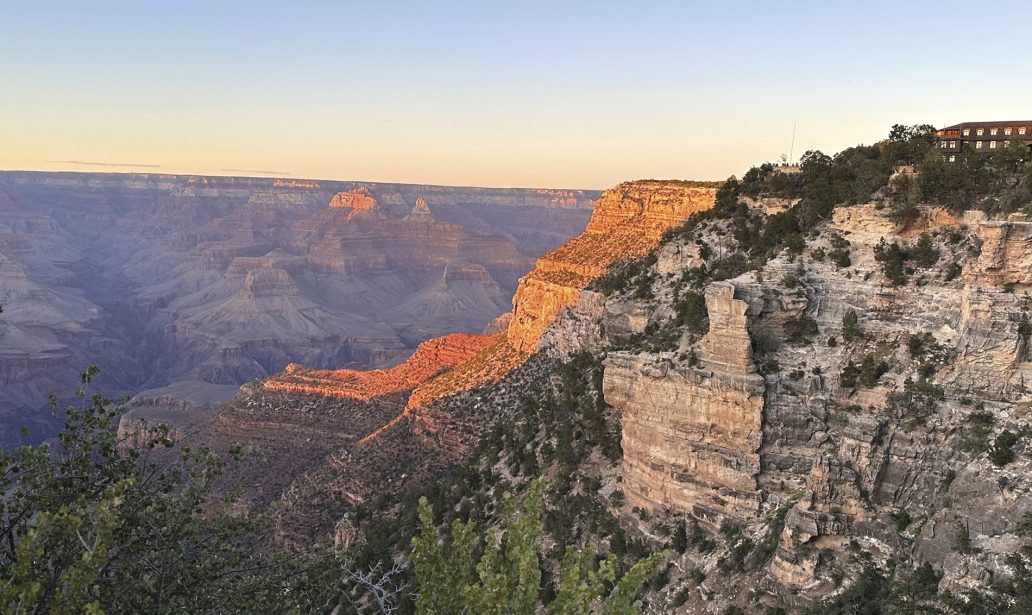
Our final destination was the Grand Canyon. There is no better way to appreciate the scale and drama of one of America’s most treasured national parks than from the air. We flew aboard a small plane, giving every passenger a window seat. Our flight followed the Colorado River through the Grand Canyon toward our landing spot near Grand Canyon Village, offering unforgettable views.
We spent the next two days exploring portions of the 13-mile Rim Trail. Staying just steps from the canyon rim, we were able to experience the dramatic views of the canyon at sunrise and sunset. We enjoyed meals at the iconic El Tovar Hotel. Built of native stone, weathered timber, soaring log-beamed ceilings, and massive fireplaces – and located steps from the South Rim of the canyon – it has welcomed guests since 1905.
My sister and I agreed it was an unforgettable journey. We were amazed that we could experience so much in just ten days. Although each park belonged to the same region, each one possessed its own colors, shapes, textures, and personality. Perhaps writer and historian Wallace Stegner said it best when he described America’s national parks as “the best idea we ever had” – a uniquely American gift to the world.